
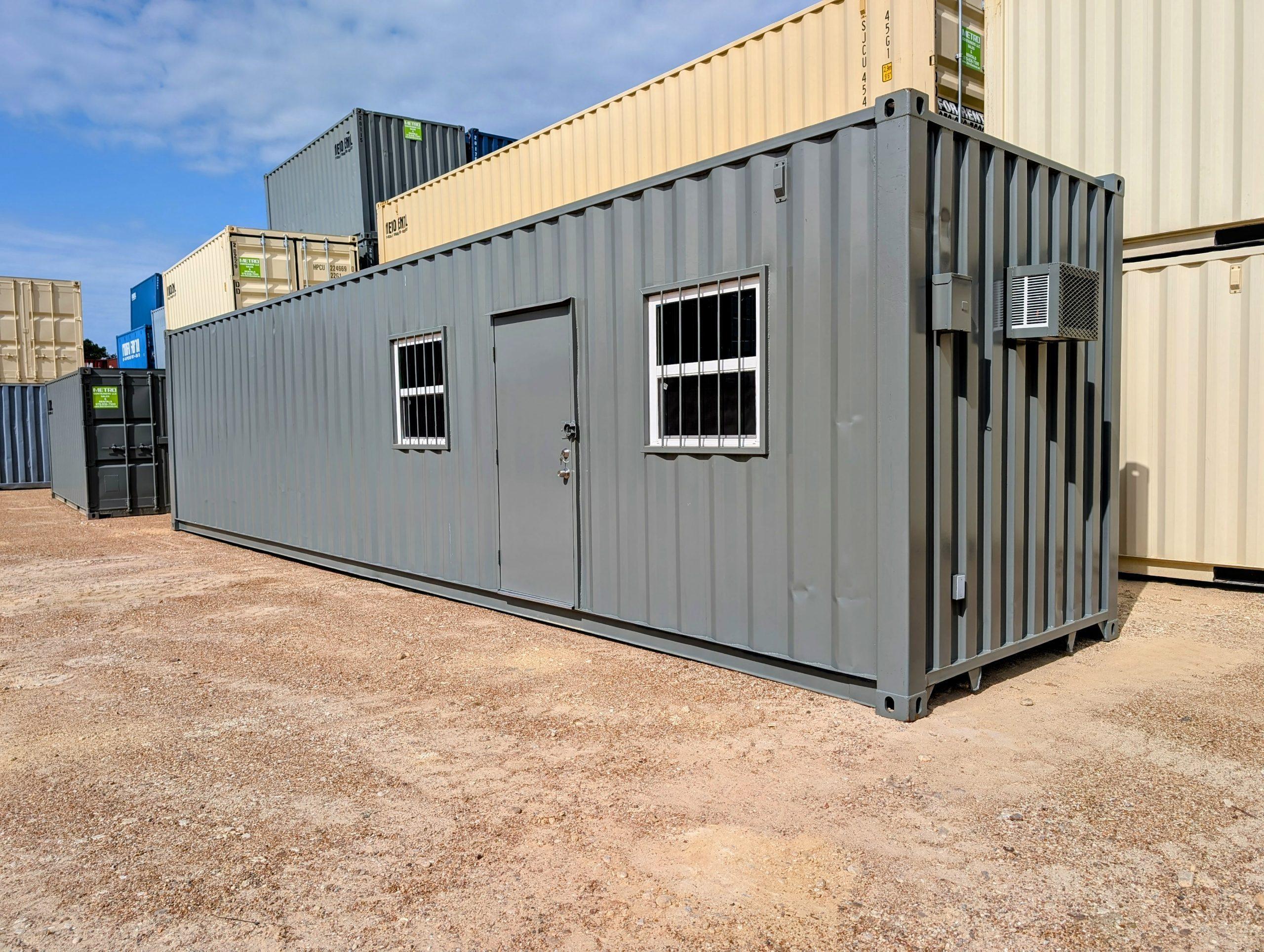
Mobile storage delivery in Fort Collins works in seven steps: get a quote, lock a delivery window, prep the placement spot, confirm the day before, take delivery, load at your pace, and schedule pickup or transport. Most local jobs run 2 to 5 business days from booking. On-site placement takes 30 to 45 minutes.
This guide walks through what actually happens in a Fort Collins driveway, what the city and county want from you, and what to plan for before the truck arrives.
The two delivery methods used in Fort Collins
Two different setups can show up at your address. They are not the same.
Ground-level semi-trailer delivery
A semi tractor backs the trailer onto a flat surface. The trailer sits at deck height. You walk up the rear ramp or roll items in through the swing doors. There is no separate lift system involved.
This is how most Fort Collins jobs run when the customer needs a 48ft storage trailer rental or longer. The big advantage is loading. Heavy items like washers, gun safes, and pallet jacks roll right in. Nothing tilts during placement. Nothing shifts inside.
The trade-off is space. A trailer needs about 60 feet of straight maneuvering room. Tight cul-de-sacs and short driveways do not work.
Lift-delivered shipping containers
A tilt-bed truck pulls up. The bed angles down. The container slides off and sits flat on the ground. National brands use a separate lift system (PODS calls theirs PODZILLA, UNITS calls theirs ROBO-UNIT). Both keep the container level during placement.
Most local providers, including local storage container rentals in 10ft, 20ft, and 40ft sizes, deliver this way. The 40ft container is 8 feet 6 inches tall and 8 feet wide. The truck needs about 33 feet of clearance to set it down.
Which method fits which property
Straight driveways 60+ feet deep are ideal for a trailer drop. Tighter spots with a stable surface usually work better with a container. The provider should figure this out with the customer on the quote call.
The 7-step Fort Collins delivery process
Here is the full sequence for a typical local job.
Step 1: Get a quote and lock a delivery window
The provider needs three things to quote: address, container or trailer size, and the rental term. Most quotes come back the same business day. Booking 1 to 2 weeks ahead is standard. Peak weeks need 3 to 4 weeks of lead time.
Step 2: Confirm the placement spot and clearances
Walk the property and pick the spot. Measure two things: ground length for the unit, and the corridor the truck needs to swing in. A trailer needs 60 feet of straight approach or a wide turning arc. A container drop needs 33 feet for the tilt-bed plus the container length.
Check overhead too. Power lines below 14 feet, low branches, and roof eaves all matter. Catching a problem on the call is far cheaper than catching it at delivery.
Step 3: Handle permits and HOA notifications
Most Fort Collins driveway placements do not need a city permit. Street placement is different. A unit on the public right-of-way requires a Right-of-Way (Encroachment) permit from the City of Fort Collins. Apply at fcgov.com 5 to 10 business days before delivery.
Homeowners in an HOA should send the board a written notice with the dates, the size, and the placement spot. Most Fort Collins HOAs reply within 3 to 7 days. A few prohibit visible containers. CC&Rs control here.
Step 4: Day-before confirmation
The afternoon before delivery, the dispatcher calls or texts to confirm the address, the time window, and the placement spot. A 2-hour window is normal. The driver calls again about 30 minutes out.
Step 5: Delivery and placement
The driver arrives, walks the spot with the customer if anyone is home, and positions the unit. Most placements take 30 to 45 minutes from when the truck pulls in. The driver levels the unit, confirms the doors open clean, and leaves a placement record.
The customer does not need to be present. A note on the door or a text to the dispatcher with placement details works fine. The driver photographs the placement before leaving.
Step 6: Load at your pace
The unit belongs to the customer for the rental term. Most loads run 1 to 4 weeks. The customer supplies a padlock and keeps the keys.
Step 7: Pickup, transport, or move to a yard
When loading is done, a call to the provider triggers pickup. Three options usually exist: empty the unit and the provider hauls it back, move the loaded unit to a new address, or store the loaded unit at the provider’s secure storage facility. Most local yards offer daylight access seven days a week.
How long does delivery take in Fort Collins?
Most Fort Collins deliveries happen 2 to 5 business days after booking. Same-week is common in slow seasons. On-site placement runs 30 to 45 minutes.
Three things change the timeline:
- Day of the week. Tuesday through Thursday are fastest. Mondays and Fridays book up earlier.
- Season. August and May (CSU move-in and move-out) need 3 to 4 weeks of lead time. Mid-December through early January is a second peak. October is the easiest month to schedule.
- Distance from the provider’s yard. Jobs inside Fort Collins city limits are next-day-friendly. Cheyenne, Greeley, and southern Loveland trips usually run on a set route, 1 to 2 days a week.
A 30-minute radius from a Fort Collins yard generally puts an address on a daily route.
Driveway and property requirements
Most Fort Collins driveways work. A few do not. Here are the limits.
Clearance for trailer delivery
- Width: 12 feet
- Height: 15 feet
- Length for maneuvering: 60 feet straight, or a wide turning arc
Clearance for container delivery
- Width: 12 feet
- Height: 15 feet
- Length for maneuvering: 33 feet
Slope
A steep driveway is the most common reason a delivery fails. Grades steeper than about 15 percent (a one-foot rise over six feet of run) are usually a problem. There is a quick test: park a car nose-up on the slope and open the door. If the door swings shut on its own, the grade is too steep.
Surface
Asphalt and concrete are ideal. Compacted gravel works for most jobs (common in Wellington, Livermore, and rural Larimer County). Wet grass and soft dirt do not. Spring mud season (March through May) is the highest-risk window for surface damage.
Overhead obstacles
A walk-through 24 hours before delivery should check for:
- Low branches under 15 feet
- Power and cable lines below 14 feet
- Mailboxes, fence posts, and gate arms in the swing path
- Sprinkler heads and irrigation lines under the placement spot
Trim or move what can be moved. Flag what cannot.
Fort Collins permits, right-of-way, and HOA rules
Three jurisdictions can affect a placement: the City of Fort Collins, Larimer County (outside city limits), and the local HOA.
When a city permit applies
Driveway placements on private property usually do not require a Fort Collins permit. Street placement does. A container or trailer that sits in the public right-of-way (the strip from the property line to the curb, including the street itself) needs a Right-of-Way (Encroachment) permit from City of Fort Collins Engineering. Apply at fcgov.com 5 to 10 business days before delivery.
Larimer County jurisdictions
Addresses outside Fort Collins city limits (most of Wellington, Bellvue, Laporte, and parts of Timnath) fall under Larimer County rules. The county is more permissive on driveway placement but still has setback requirements from property lines. Larimer County Planning handles specifics.
HOA notification
A short letter or email to the HOA board, sent 1 to 2 weeks ahead, prevents most problems. Useful items to include:
- The size of the unit (10ft, 20ft, 40ft, 48ft trailer, 53ft trailer)
- The placement spot (driveway, side yard, etc.)
- The on-site dates
- A contact phone number
Most Fort Collins HOAs allow temporary placement during a move or renovation. Some cap it at 7 to 14 days. A few prohibit visible storage units entirely. The CC&Rs are the final word.
Old Town Fort Collins historic district
Old Town has tighter aesthetic and access rules. Narrow alleys, mature tree cover, and historic preservation guidelines all apply. Side-yard placement is usually preferred over a street-facing driveway. Addresses inside the historic district should call the provider before booking.
Weather and seasonal timing in Northern Colorado
Weather changes the playbook in Fort Collins. Each season brings a different set of considerations.
Winter (November to February)
Year-round delivery is normal in Fort Collins. Snow and ice change two things: the placement spot needs to be cleared before the truck arrives, and frozen ground is sometimes more forgiving than spring mud. Black ice on a sloped driveway is a hard no.
Spring mud season (March to May)
This is the highest-risk window for yard damage. Saturated soil and snowmelt mean a truck can rut a lawn or a gravel driveway in minutes. Plywood or steel pads under the wheels often save the surface. If the site is too soft, most providers will reschedule rather than risk damage.
Summer storms and chinook winds
Fort Collins gets chinook winds rolling off the Front Range, sometimes 60 to 90 mph. Most providers will not deliver during a National Weather Service High Wind Warning. A loaded trailer with the door rolled up acts like a sail. Summer afternoon thunderstorms can also force a reschedule, but they usually pass within an hour.
Fall (September to early November)
The easiest window to schedule. Stable weather, dry ground, lighter demand. Flexible timelines should aim here.
How to prepare your property the day before
A useful checklist 24 hours before the truck arrives:
- Clear the driveway of cars, bikes, trash bins, and toys.
- Pick up loose items in the yard near the placement spot. Chinook winds will move them.
- Trim or tie back branches under 15 feet.
- Sweep snow, ice, or mud from the spot in winter.
- Mark sprinkler heads with flags so the driver can avoid them.
- Confirm any gate code or alarm with the dispatcher.
- Tell adjacent neighbors that a truck will be on the street briefly.
- Have a padlock ready. Most providers do not supply one.
- Photograph the driveway before delivery to establish a baseline.
- Keep a phone on. The driver calls about 30 minutes out.
Container size guide for Fort Collins homes and job sites
Pick the size by what is being moved, not by the home’s square footage.
- 10ft container. Apartment, dorm room, partial garage, motorcycle plus a few boxes. A common pick for CSU students.
- 20ft storage container rental. A 2-bedroom home, most condos, or a small business overflow. The most popular residential size.
- 40ft container. A 4 to 5-bedroom home, a full job site for a contractor, or restaurant kitchen storage during a remodel.
- 48ft and 53ft semi-trailers. Whole-house moves, full warehouse overflow, or multi-room renovations. Ground-level loading makes these the easiest to fill fast.
When one unit will not hold the load, two units staggered over different dates is usually cheaper than upgrading to the next size up. Side-by-side placement needs about 25 feet of width and 15 feet of overhead clearance.
What it costs in Fort Collins
Mobile storage providers in Fort Collins price by a flat rate, not by the hour. The biggest drivers:
- Size. A 10ft container is the entry price. A 53ft trailer is the top of the range.
- Rental term. Monthly is the standard. Longer terms get better monthly rates.
- Delivery distance. Inside Fort Collins is the lowest cost. Cheyenne, Greeley, and Sterling are higher.
- Peak season. August and May (CSU weeks) and December book up first and price firmest.
- Yard storage. Storing the loaded unit at the provider’s facility adds a small monthly fee on top of the rental.
A simple driveway drop in Fort Collins for a 20ft container, one month, picked up empty, sits at the low end. A 53ft trailer with multi-month yard storage and a relocation drop sits at the high end. Most quotes turn around the same business day.
Mobile storage versus the alternatives
Three options compete for a Fort Collins move: a portable container or trailer, a self-storage unit, and a moving truck.
- Mobile storage wins when on-site loading on the customer’s timeline matters, with secure off-site storage as a backup option. It is also the cheapest path for a local move with self-loading.
- Traditional self-storage wins when monthly access in a climate-controlled space matters and the driveway will not work. It loses on the load-twice problem (load truck, unload at the unit, load again on move day, unload at home).
- A rental truck wins for a same-day, single-shot move. It loses on flexibility and on the deposit.
For more on the trailer-versus-pod question specifically, see this side-by-side PODS comparison.
Frequently asked questions about Fort Collins delivery
Do I need a permit for a storage container in Fort Collins?
A permit is usually not required for a container on private property in Fort Collins. A Right-of-Way (Encroachment) permit from the City of Fort Collins is required when the container will sit on the street or public right-of-way. Apply at fcgov.com 5 to 10 business days before delivery. HOA approval is a separate step.
How long does it take to deliver a storage container in Fort Collins?
Most Fort Collins deliveries happen 2 to 5 business days after booking. Same-week is common in October, November, March, and April. Peak weeks (CSU move-in in August, move-out in May) need 3 to 4 weeks of lead time. On-site placement runs 30 to 45 minutes.
Can a 40ft container fit in a residential driveway in Fort Collins?
A 40ft container fits if the driveway is at least 60 feet deep with no overhead obstructions under 15 feet. The container itself is 40 feet long. The tilt-bed truck needs another 20 feet of working room behind it. Most ranch-style homes in Harmony, Rigden Farm, and Fossil Lake have driveways that work. Older Old Town lots usually do not.
How is a semi-trailer delivery different from a portable storage pod?
A semi-trailer is delivered at ground level by a tractor that backs it into place. The rear doors open at ground level via a ramp. A portable pod is set down by a separate lift system (PODZILLA from PODS, ROBO-UNIT from UNITS) and sits flat on the ground. Trailers fit longer items and roll-in cargo. Pods fit tighter spots.
Will mobile storage delivery damage my driveway?
Damage is rare on asphalt and concrete. The risk goes up on wet grass, soft dirt, or saturated gravel during spring mud season. Plywood or steel pads usually solve borderline surfaces. A photograph of the driveway before delivery establishes a useful baseline.
Can mobile storage be delivered in winter in Fort Collins?
Yes. Year-round delivery is normal. The placement spot needs to be cleared of snow and ice before the truck arrives. Most providers will not deliver during a National Weather Service High Wind Warning, which is the most common chinook wind cancellation reason in Fort Collins.
How far ahead should I book mobile storage in Fort Collins?
For most months, 1 to 2 weeks is enough. CSU move weeks (August 15 to August 25 and May 5 to May 20) need 3 to 4 weeks of lead time. Year-end moves (December 15 to January 5) need 2 to 3 weeks.
What happens if the driver cannot deliver to my property?
If the spot will not work on arrival (low branches, soft ground, blocked driveway), the provider reschedules. A trip charge usually applies for the wasted run. Catching the problem on the quote call is faster and cheaper than discovering it at delivery.