
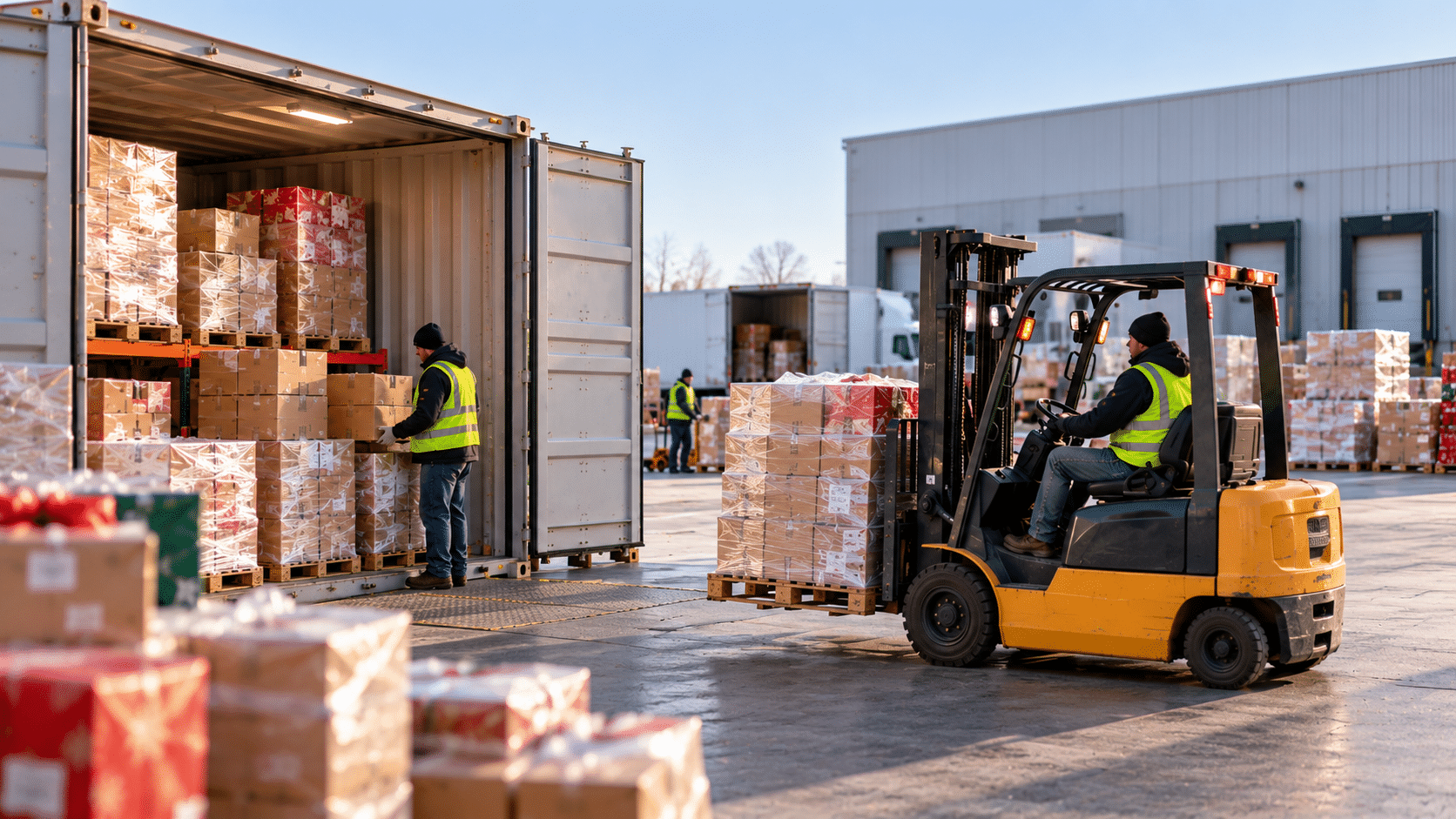
Holiday inventory shows up faster than most backrooms can absorb it. For a few months a year, a Fort Collins retailer, distributor or farm supply business may need double its normal floor space, then need none of it by February.
That is the problem temporary warehousing solves. This guide covers what it is, how storage containers and semi trailers compare with leasing warehouse space, how much inventory each unit actually holds, and when overflow warehouse storage in Fort Collins makes more sense at your site or at our 12-acre yard on US Hwy 287.
What Is Temporary Warehousing, and Who Uses It?
Temporary warehousing is short-term storage capacity added for a defined period, usually weeks or months, to handle inventory that exceeds a business’s normal space. It can mean renting space in a third-party warehouse, or placing storage containers or semi trailers at your site. Businesses use it for seasonal peaks, bulk purchases, and projects that temporarily displace stock.
There are two broad forms:
- Space in someone else’s building. A third-party logistics (3PL) warehouse or a short-term lease. You get racking, docks and sometimes staff, but your goods are off-site and you pay for handling.
- Mobile storage units. Steel shipping containers or dock-height semi trailers placed at your property or stored at a secure yard. You load and access them yourself, on your schedule.
Fort Collins Mobile Storage provides the second form. We rent storage containers and semi trailers and store them at our yard. We do not operate a staffed warehouse, so we do not offer pick-and-pack, racking or inventory management.
Common seasonal uses in Northern Colorado
- Holiday retail inventory. Stores bring in gift stock, decor and promotional goods in October and November, then deal with returns into January. A 48ft storage trailer at the loading dock acts as an extra stockroom for that window.
- Seasonal merchandise rotation. Garden centers, sporting goods stores and outdoor retailers swap seasonal lines twice a year. Off-season stock can sit in a container until spring.
- Agricultural equipment and supplies. Agriculture is a major industry here. Weld County alone sold about $2.4 billion in agricultural products in 2022, roughly 26% of Colorado’s total, according to the USDA Census of Agriculture. Farms and ranches use containers and trailers for seed, feed, tools and harvest overflow.
- Temporary business storage. Remodels, store relocations, bulk buys at a discount, and event inventory between shows all create short-term space needs.
Storage Containers vs. Renting Warehouse Space: Costs, Flexibility, and Lease Terms
For a seasonal peak, containers and trailers usually cost less and commit you to far less. Commercial warehouse leases typically run three to seven years and take months to secure. FCMS container and trailer rentals have a one-month minimum and no long-term contract. A warehouse wins when you need racking, climate control, staff or year-round space.
What a warehouse lease commits you to
Industrial space in Northern Colorado is tight. CBRE reported a 3.0% industrial vacancy rate for Northern Colorado in the first half of 2026, with an average direct asking rate of $11.74 per square foot per year on a triple-net (NNN) basis. The Fort Collins submarket was tighter, at 2.3% vacancy and about $13.67 per square foot (CBRE Northern Colorado Industrial Figures, H1 2026).
Triple-net means taxes, insurance and common-area maintenance are billed on top of that rate. Industry sources such as Link Logistics put typical warehouse lease terms at three to seven years, with five years most common.
A simple illustration: 2,000 square feet at $13.67 per square foot is about $27,300 a year in base rent before NNN charges. Over a five-year term that is a commitment of more than $136,000 for space you may only need three months a year.
How container and trailer rentals compare
| Factor | Warehouse lease (industry typical) | FCMS container or trailer rental |
|---|---|---|
| Minimum commitment | Usually 3 to 7 years | One month, prorated at the start |
| Time to set up | Weeks to months to find, negotiate and fit out | Trailers usually delivered within a few business days of booking |
| Cost structure | Base rent per sq ft plus taxes, insurance and maintenance | Flat monthly rent plus a delivery fee quoted by location |
| Scaling | Fixed square footage | Add or remove units as volume changes |
| Location | The building’s address | At your property or at our yard |
| Racking, lighting, climate control | Often included or can be added | Not included |
| Staff and inventory handling | Available at 3PL warehouses | You handle your own goods |
Starting monthly rates for each unit are listed on our container rentals and trailer rentals pages. Delivery is quoted separately as a flat rate based on distance from our yard.
Where containers and trailers fall short
Be honest about the trade-offs before you choose:
- No climate control. Units are wind- and water-tight, not heated or cooled. Fort Collins winters regularly drop below freezing, which matters for liquids, candles, cosmetics, electronics with batteries, and some food products.
- No racking or lighting. You stack on the floor or bring your own shelving. Plan for a flashlight or portable light for evening access.
- Narrower aisles. Interior width is under 8 feet in a container and a little over 8 feet in a trailer. Picking individual SKUs from the back of a full unit is slow.
- Your labor. Nobody receives, counts or ships goods for you.
If your holiday overflow is boxed, palletized and stable at outdoor temperatures, these limits rarely matter. If you need daily picking of hundreds of SKUs, a 3PL warehouse may be the better tool.
How Much Inventory Fits in a 20-Foot or 40-Foot Container vs. a 48-Foot or 53-Foot Trailer?
A 20-foot container holds about 10 standard 48 x 40 inch pallets on the floor and roughly 1,170 cubic feet. A 40-foot container holds about 20 pallets and 2,390 cubic feet. A 48-foot trailer holds about 24 pallets, and a 53-foot trailer about 26 pallets and up to roughly 4,000 cubic feet.
The figures below are industry-standard approximations for single-stacked GMA pallets (48 x 40 inches). Interior dimensions vary slightly by manufacturer and unit age, so treat them as planning numbers, not guarantees.
| Unit (FCMS rental) | Approx. interior (L x W x H) | Approx. volume | Floor pallets (48×40) | Loading access | Best fit |
|---|---|---|---|---|---|
| 10ft container | 9’4″ x 7’8″ x 7’10” | 570 cu ft | About 4 | Ground level, end doors | Small shops, tight lots |
| 20ft container | 19’4″ x 7’8″ x 7’10” | 1,170 cu ft | 9 to 10 | Ground level, end doors | Single-store holiday backstock, farm supplies |
| 40ft container | 39’5″ x 7’8″ x 7’10” | 2,390 cu ft | 20 to 21 | Ground level, end doors | Larger retail overflow, seasonal merchandise |
| 40ft high cube container | 39’5″ x 7’8″ x 8’10” | About 2,690 cu ft | 20 to 21 (taller stacks) | Ground level, end doors | Tall or light goods stacked high |
| 48ft storage trailer | About 47’6″ x 8’2″ x 8’6″ to 9′ | 3,000 to 3,500 cu ft | 24 | Dock-height rear doors | Retail and warehouse overflow at a dock |
| 53ft storage trailer | About 52’6″ x 8’2″ x 9′ | 3,800 to 4,000 cu ft | 26 | Dock-height rear doors | Distribution and high-volume holiday stock |
How to size your overflow
- Count pallet positions, not boxes. Estimate how many pallets of overflow you will hold at the peak week, not the average.
- Check stack height. Pallets that can be safely double-stacked roughly double the counts above, if weight and box strength allow. Most holiday retail stock cannot be double-stacked without crushing.
- Leave an aisle if you pick from it. A unit you pull from weekly needs a walkway, which costs several floor positions. Plan to fill it short of the full counts above.
- Match the unit to your loading method. Trailers sit at dock height, around 4 feet up, and suit forklifts and pallet jacks at a loading dock. Containers sit near ground level and suit hand trucks or forklifts from the ground. Without a dock, a portable ramp works for hand-loading a trailer.
Example: a retailer expecting 18 pallets of holiday stock, picked twice a week, would outgrow a single 40ft container once aisle space is counted. A 48ft trailer at the dock, or a 40ft container plus a 20ft container, covers it.
On-Site Storage vs. Storage at FCMS’s 12-Acre Secure Yard
Keep units at your property when you need daily or weekly access to the inventory. Store them at the FCMS 12-acre yard on US Hwy 287 when space at your site is tight and you need the stock less often. The yard is fenced, gated with a coded keypad, and has an on-site manager 24 hours a day.
On-site at your business or farm
On-site storage is the default for holiday retail. The unit sits next to your back door or dock, and staff can restock the sales floor in minutes.
It works when you have:
- A level, firm spot with room for the delivery truck to set the unit
- Permission from your landlord, HOA or property manager
- Clearance under City of Fort Collins or Larimer County rules for temporary structures (see the FAQ below)
We confirm access, surface conditions and placement before delivery.
At our secure storage yard
Our secure storage facility at 311 N US Highway 287, on the north end of Fort Collins, offers 12 acres of outdoor storage for trailers and containers. Published security features include:
- A 4-foot berm and a 6-foot solid fence
- Three-strand security wire
- A coded keypad entrance gate
- An on-site manager 24 hours a day, 7 days a week
- Access during daylight hours, 7 days a week
Yard storage is billed as a monthly fee on top of the unit rental. It suits stock you need weekly or less: pre-season inventory, January returns waiting for processing, off-season merchandise, or ag supplies between seasons.
Quick comparison
| On-site at your property | FCMS 12-acre yard | |
|---|---|---|
| Access | Any time you are on your property | Daylight hours, 7 days a week |
| Space at your site | Required | Not required |
| Security | Steel walls, lock bars, your own lock, your site’s security | Fence, berm, security wire, keypad gate, 24/7 on-site manager |
| Best for | Daily restocking, dock-side overflow | Low-frequency access, limited lot space |
| Extra cost | None beyond rental and delivery | Monthly yard storage fee |
How Quickly Can Businesses Get Overflow Storage in Fort Collins and Northern Colorado?
Most FCMS trailer deliveries happen within a few business days of booking, depending on location and availability. FCMS keeps over 80 containers and 200 semi trailers in stock in Fort Collins. For holiday inventory, book in September or early October, before retail freight arrives and before snow complicates placement.
Timing depends on three things: unit type and stock on the day you call, distance from our yard, and site readiness. Call (970) 493-5536 for current lead times on containers and trailers.
We deliver throughout Fort Collins, Loveland, Greeley, Windsor, Wellington, Longmont, Boulder, Denver and Cheyenne, and across Colorado, Wyoming and Nebraska.
A practical holiday timeline
| When | What to do |
|---|---|
| August to September | Estimate peak pallet count. Request a quote. Clear and confirm a placement spot. |
| Late September to October | Take delivery before holiday freight arrives. Set up a simple layout map of what is where. |
| November to December | Restock the sales floor from the unit. Keep the busiest SKUs nearest the doors. |
| January | Hold returns and leftover stock. Call for pickup, or move the unit to our yard. |
Because rentals are billed monthly with a one-month minimum and no long-term contract, a typical holiday rental runs from October through January, then ends.
Before you call, have this ready
- Delivery address and where the unit should sit
- Unit size or your peak pallet count
- Whether you have a loading dock
- Your expected start date and rough end date
- On-site or yard storage
Frequently Asked Questions
Can I store holiday retail inventory in a storage container through a Colorado winter?
Yes, for most boxed and palletized goods. FCMS rental containers are wind- and water-tight, but they are not heated or climate controlled. Inside temperatures follow outdoor conditions. Avoid storing items that can freeze, melt or crack, such as liquids, aerosols, candles and some cosmetics, unless you protect them separately.
Do I need a permit to keep a storage container at my Fort Collins business?
It depends on your zoning, placement and how long the unit stays. The City of Fort Collins regulates accessory structures, and storage containers can fall under those rules. Check with Fort Collins Building Services at (970) 416-2740 or fcgov.com/building. Properties in unincorporated Larimer County may follow different rules.
What is the minimum rental period for overflow storage?
One month. FCMS rentals have a one-month minimum, prorated at the beginning of the rental period. There is no maximum term and no long-term contract, so you can keep a unit for one holiday season or several years.
Should I rent a storage trailer or a storage container for holiday inventory?
Choose a trailer if you have a loading dock, use forklifts or pallet jacks, or need the most space per unit (up to 53 feet). Choose a container if you need ground-level access, a smaller footprint, or side-open or double-door access. Compare both on our trailer rentals page.
Can I access inventory stored at the FCMS yard on weekends?
Yes. The yard is open for access during daylight hours, seven days a week, through a coded keypad gate. Our office hours are Monday to Friday, 8:00 AM to 5:00 PM, so schedule deliveries, moves and pickups on weekdays.
Is a storage container cheaper than renting warehouse space?
For short, seasonal needs, usually yes. Warehouse leases typically require multi-year terms plus taxes, insurance and maintenance. Container and trailer rentals are a flat monthly rate with a one-month minimum, plus delivery. For year-round needs with racking and climate control, a warehouse can be the better value.
Talk to Us About Your Holiday Storage Plan
Every overflow problem is a little different: how many pallets, how often you pull from them, whether you have a dock, and how much room is behind the building. Tell us those four things and we will recommend a unit size, placement and timeline that fits. No pressure toward a bigger unit than you need.
Request a free quote or call (970) 493-5536. Fort Collins Mobile Storage has been family-owned and operated in Fort Collins for over 40 years.