
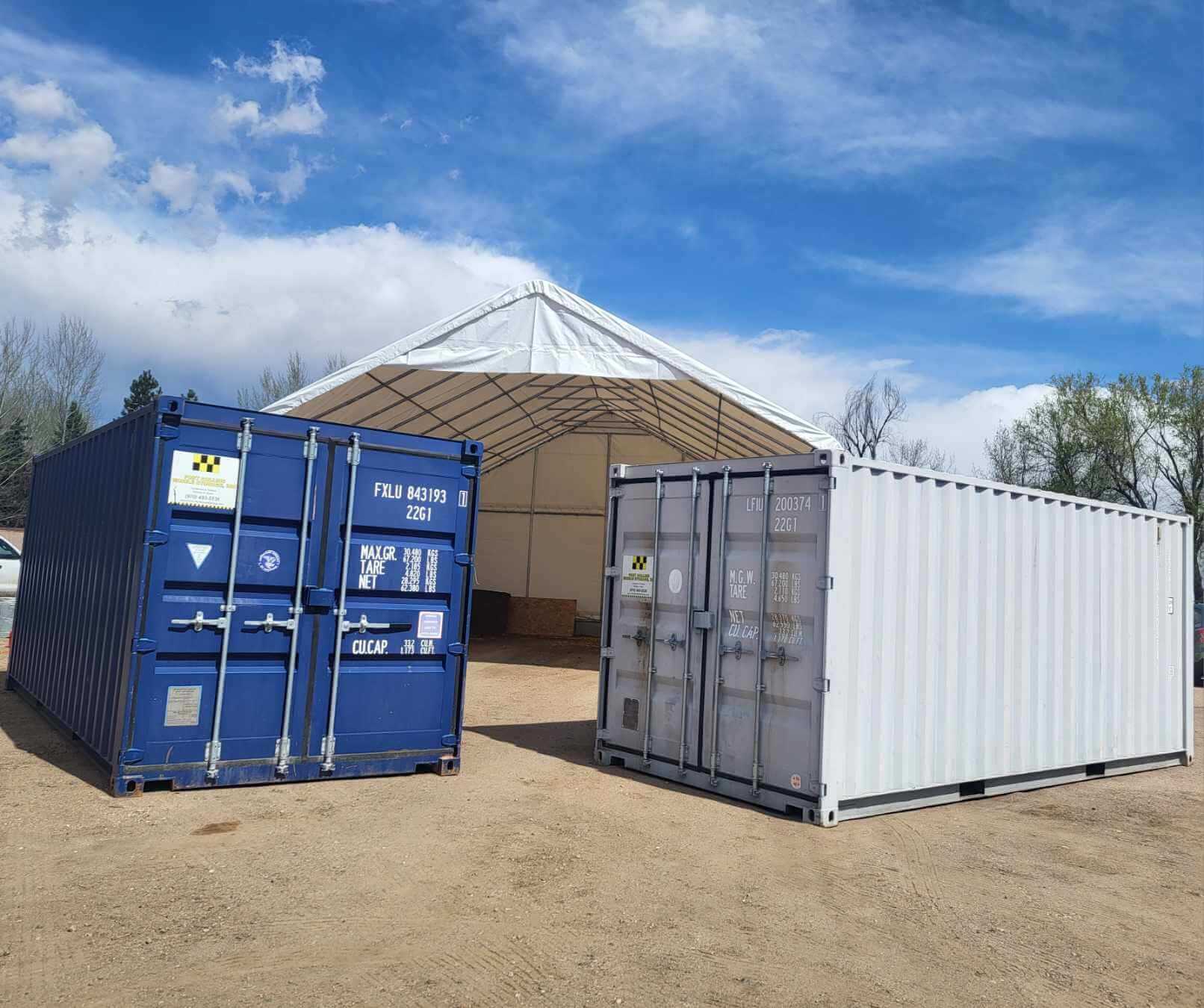
Most people pick a storage container by guessing. Then the couch won’t clear the door, or half the space sits empty while the rent keeps coming. A better way is to size the unit to your three hard limits: your biggest item, your floor space or pallet count, and the room you have on site.
This guide covers every size Fort Collins Mobile Storage rents and sells. That includes 10ft, 20ft, and 40ft containers in standard and high cube heights, side-open and double-door units, and 48ft and 53ft storage trailers. You’ll get real dimensions, door openings, pallet counts, and size picks for homes, job sites, businesses, and farms across Fort Collins and Northern Colorado.
What Size Storage Container Do I Need? (Quick Guide by Project)
For most projects, a 20ft container is the right starting point. Pick a 10ft only when site space is tight, since it starts at the same monthly rate as a 20ft. Go to a 40ft for whole-house contents, large inventory, or bulky job site materials. Pick a 48ft or 53ft trailer for dock-height loading or maximum space.
| Project | Start with | Size up when |
|---|---|---|
| One or two rooms during a small remodel | 10ft or 20ft | Garage or patio items are going in too (20ft) |
| Kitchen or multi-room remodel | 20ft | Most of the house has to be emptied (40ft) |
| Local move, smaller home or condo | 20ft | You have a garage, shop, or oversized furniture (40ft) |
| Full-house move | 40ft | You want dock loading or more room (48ft or 53ft trailer) |
| Contractor tools and materials | 20ft | Long materials or forklift-loaded pallets (40ft or side-open) |
| Retail or seasonal inventory | 20ft or 40ft | You have a loading dock (48ft or 53ft trailer) |
| Farm equipment, feed, and supplies | 20ft or 40ft | Pallets or hay loaded with a tractor or forklift (trailer) |
Size a Container in Three Checks
- Check the door first. Your biggest item has to clear the door opening, not the interior. On a standard-height container, that opening is about 7’8″ wide by 7’6″ tall. Tall shelving or upright equipment may need a high cube.
- Count floor positions. Pallets, machines, and appliances don’t stack like boxes. Count how many 48″ x 40″ footprints you need and match that to the pallet counts below.
- Add volume last. Boxes, totes, and furniture fill cubic feet. Odd shapes and an access aisle mean you never fill every cubic foot, so leave margin.
One pricing detail changes the math. On our listed starting rates, a 10ft and a 20ft both start at $125 per month, and a 40ft starts at $150. Unless a 20ft won’t fit your site, the 10ft rarely saves money. And one 40ft starts lower than two 20fts. Your final quote depends on condition, rental term, and delivery distance.
10ft vs. 20ft vs. 40ft Storage Containers (Detailed Comparison Table)
A standard 10ft container holds about 560 to 570 cubic feet, a 20ft about 1,170, and a 40ft about 2,390. High cube 20ft and 40ft units add one foot of height. All three are 8ft wide outside and share a standard door opening of about 7’8″ wide by 7’6″ tall.
What Fort Collins Mobile Storage Offers in Each Size
These details come from our own product pages. They are what you can actually rent or buy from our Fort Collins yard.
| FCMS detail | 10ft | 20ft | 40ft |
|---|---|---|---|
| Exterior size, standard (L x W x H) | 10′ x 8′ x 8.5′ | 20′ x 8′ x 8.5′ | 40′ x 8′ x 8.5′ |
| Exterior size, high cube | Not offered | 20′ x 8′ x 9.5′ | 40′ x 8′ x 9.5′ |
| Condition | New (one-trip) only | New or used | New or used |
| Rent or buy | Both | Both | Both |
| Starting rental rate | $125/month | $125/month | $150/month |
| Rental page | 10ft rental | 20ft rental | 40ft rental |
| Sales page | 10ft for sale | 20ft for sale | 40ft for sale |
The 10ft is limited stock, so call to check availability before you plan around it. All rentals carry a one-month minimum, prorated at the start.
Interior Dimensions, Door Openings, and Pallet Capacity
These are typical industry figures for ISO shipping containers. Interior numbers vary by a few inches between manufacturers. Treat them as planning numbers and confirm any tight fit before you load.
| Typical spec | 10ft | 20ft standard | 20ft high cube | 40ft standard | 40ft high cube |
|---|---|---|---|---|---|
| Interior (L x W x H) | 9’3″ x 7’8″ x 7’10” | 19’4″ x 7’8″ x 7’10” | 19’4″ x 7’8″ x 8’10” | 39’5″ x 7’8″ x 7’10” | 39’5″ x 7’8″ x 8’10” |
| Door opening (W x H) | 7’8″ x 7’6″ | 7’8″ x 7’6″ | 7’8″ x about 8’5″ | 7’8″ x 7’6″ | 7’8″ x about 8’5″ |
| Floor area | About 71 sq ft | About 148 sq ft | About 148 sq ft | About 302 sq ft | About 302 sq ft |
| Volume | About 560 cu ft | About 1,170 cu ft | About 1,310 cu ft | About 2,370 to 2,390 cu ft | About 2,690 cu ft |
| Standard pallets (48″ x 40″), single-stacked | About 4 | About 9 to 10 | About 9 to 10 | About 20 to 21 | About 20 to 21 |
Our FAQs list our own volume figures as about 570, 1,170, and 2,390 cubic feet for standard 10ft, 20ft, and 40ft units. Pallet counts assume no overhang and depend on how the pallets are turned.
When High Cube Is Worth It
High cube adds a foot of height, not floor space. That matters only if you stack tall. Think double-stacked pallets, tall shelving units, or upright equipment that clears 7’6″ but not much more. If your load is furniture and boxes, a standard height unit usually does the job.
When Does a 48ft or 53ft Storage Trailer Make More Sense?
Choose a storage trailer when you need more room than a 40ft container or you load with a forklift or pallet jack at a dock. Our 53ft trailer holds roughly 4,000 cubic feet, about 1.7 times a standard 40ft container. Trailers sit at dock height, so a site without a dock needs a ramp.
| 40ft container | 48ft storage trailer | 53ft storage trailer | |
|---|---|---|---|
| Loading height | Ground level | Dock height, rear entry | Dock height, rear entry |
| Volume | About 2,390 cu ft | About 3,500 cu ft (typical 48ft van) | About 4,000 cu ft |
| Standard pallets, single-stacked | About 20 to 21 | About 24 (typical) | About 26 (typical) |
| Rent or buy | Both | Rent | Rent |
| Starting rental rate | $150/month | $200/month | $250/month |
Three questions settle it:
- Do you have a loading dock, forklift, or pallet jack? A trailer lines up with the dock and lets equipment roll straight in.
- Is your load bigger than about 20 pallets or a full large house? That’s past a 40ft container’s floor space.
- Can your site take a semi? A trailer needs a long, straight approach. Our guide on how mobile storage delivery works covers clearances.
If you answered no to the first two, a 40ft container is usually simpler. It sits at ground level, so you can walk or hand-truck items in without a ramp. See all storage trailer rentals or go straight to the 48ft trailer or 53ft trailer.
When Should You Choose Side-Opening or Double-Door Containers?
Choose a side-open container when you need to reach everything along the long wall, load pallets from the side with a forklift, or store wide or long items. Choose a 40ft double-door container when you want access from both ends or two separate storage zones in one unit.
| Configuration | Door location | Heights | Condition | Starting rental rate |
|---|---|---|---|---|
| 20ft side-open | Full-length side doors | Standard only | New (one-trip) | $195/month |
| 40ft side-open | Side opening along the length | Standard only | New (one-trip) | $225/month |
| 40ft double-door | Double doors on each end | Standard or high cube | New only | $180/month |
All three are also available to buy through our container sales page.
Side-Open Containers
A standard container is a long tunnel. Whatever you load first ends up 20 or 40 feet from the door. Side-open units fix that. Every pallet, bin, or machine along the wall stays within reach, and a forklift can set pallets in from the side instead of pushing them down the length.
They cost more than an end-door unit and only come in standard height. Pick one when access speed matters more than rent. Contractors pulling materials daily and businesses picking inventory by SKU get the most out of them. Plan placement so the long side faces open ground, not a fence or building.
40ft Double-Door Containers
A 40ft double-door container has double doors on both ends. You get 40 feet of space with no spot more than 20 feet from a door. It also splits cleanly into two zones, such as tools at one end and materials at the other.
It starts $30 per month above a standard 40ft rental. That’s worth it when you’d otherwise dig to the back of a 40ft container every week.
Storage Container Sizing by Project (Remodeling, Moving, Job Sites, Business Inventory, Farm Equipment)
Match the unit to how you’ll load and reach your things, not only how much you store. Remodels and moves usually fit a 20ft or 40ft. Job sites benefit from side-open or double-door access. Businesses with a dock gain the most from trailers. Farms often buy, since owning can cost less than renting long term.
Remodeling
A kitchen or bathroom remodel usually means emptying one or two rooms plus whatever lives in the way. A 20ft container in the driveway handles that for most Fort Collins homes. If the project touches most of the house, or flooring runs through every room, go to a 40ft. Load the things you won’t need until the end in the back. Remodels run long, so it helps that extending a rental is a phone call.
Moving
A 20ft container fits the contents of a smaller home or condo. A full house, especially one with a garage or shop, points to a 40ft. For large homes, a 53ft trailer gives you roughly 4,000 cubic feet in one unit. When you finish loading, we can move the unit to your new address or hold it at our secure storage facility on US Hwy 287 until you’re ready.
Job Sites
For tools and small equipment, a 20ft container is the standard pick. Long lumber, pipe, and palletized materials push you to a 40ft or a side-open unit. On sites with two crews or two trades, a 40ft double-door lets each work from its own end. If the crew also needs a workspace, we rent a 20ft mobile office. We deliver to job sites across Fort Collins, Loveland, Greeley, Windsor, and Longmont.
Business Inventory
Count pallets before you count square feet. Up to about 10 pallets fits a 20ft. Up to about 20 fits a 40ft. Past that, or if you already ship and receive at a dock, a 48ft or 53ft trailer is the better tool. Retailers working holiday or back-to-school spikes often park a trailer at the dock and avoid a second warehouse lease. If you pick by SKU, consider a side-open unit so nothing gets buried.
Farm Equipment and Agricultural Storage
Farms and ranches across Larimer and Weld County use 20ft and 40ft containers for equipment, seed, feed, tools, and supplies. Measure your largest implement against the 7’8″ door width before you choose. If you need storage for years, buying often wins. Our FAQs note that buying may cost less than renting over 12 to 18 months. For hay and palletized supplies loaded with a tractor or forklift, a dock-height trailer is worth a look.
Frequently Asked Questions About Storage Container Sizes
How many pallets fit in a storage container?
A 20ft container fits about 9 to 10 standard 48″ x 40″ pallets on the floor, single-stacked. A 40ft fits about 20 to 21, and a 10ft about 4. High cube units hold the same floor count but allow taller stacks. Exact counts depend on pallet orientation and overhang.
What is the difference between a standard and a high cube container?
A high cube is one foot taller: 9.5ft outside versus 8.5ft. That raises interior height to about 8’10” and door height to about 8’5″. We offer high cube in 20ft, 40ft, and 40ft double-door units. Our 10ft and side-open units come in standard height only.
Will tall furniture or equipment fit through a container door?
Measure the door, not the interior. A standard-height container door opens about 7’8″ wide by 7’6″ tall. A high cube door is about 8’5″ tall. Anything taller has to go in on its side, or into a 48ft or 53ft trailer, which typically has a taller rear door.
Is one 40ft container cheaper than two 20ft containers?
On our listed starting rates, yes. A 40ft rental starts at $150 per month. Two 20ft rentals start at $250 combined, before delivery fees. Two 20fts make sense only when you need storage in two places or your site can’t fit a 40ft.
Is a 10ft container cheaper than a 20ft?
Not on starting rental rates. Both start at $125 per month. Choose the 10ft when a 20ft won’t fit your property or job site. Our 10ft units are new (one-trip), standard height, and limited stock, so call to check availability.
How much does a 53ft storage trailer hold?
Our 53ft storage trailer holds roughly 4,000 cubic feet. It is the largest mobile storage option we carry. A standard 53ft trailer typically takes about 26 standard pallets single-stacked. It loads at dock height from the rear and starts at $250 per month.
Should I size up or down if I’m between two sizes?
Size up. Running out of room means a second unit, a second delivery, and a second monthly rate. Going from a 20ft to a 40ft adds $25 to the starting monthly rate. Size down only when the larger unit won’t fit your site or delivery path.
Get the Right Size the First Time
Tell us what you’re storing, your largest item, and where the unit is going. We’ll match the size and configuration before anything leaves our yard. Call (970) 493-5536 or request a free quote. For rental terms, delivery areas, and pricing, see our mobile storage FAQs or browse all storage container rentals.